
UIPM 2026 Masters World Championships: Cape Town celebrates a sport for life


Former Olympians still buzzing off the thrill of competition, newcomers discovering Pentathlon in their 50s and athletes in their 70s embracing the new challenge of Obstacle Racing. The UIPM 2026 Masters World Championships in Cape Town (RSA) offered an uplifting celebration of sporting ambition, adaptability and friendship across generations.
The Championships brought together athletes representing 18 nations across all five UIPM Confederations. With age categories ranging from 30+ to 70+, the event demonstrated that Pentathlon really is a sport for life.
South Africa fielded the largest delegation, reflecting the strength of the Masters movement in the host nation. Alongside familiar faces returning to international competition were first-time participants and athletes who had progressed from Biathle, Triathle and Laser Run towards the full Pentathlon challenge.
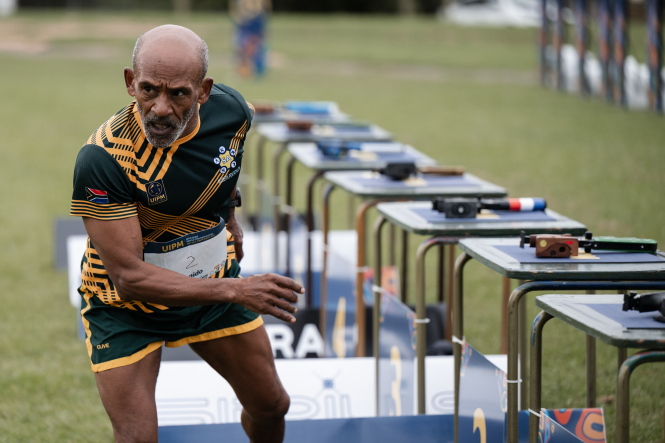
UIPM President Rob Stull OLY, who attended the Championships, welcomed the occasion as another positive milestone for the sport in Africa and the revival of the international Masters community.
UIPM President Rob Stull OLY said: “This was a wonderful moment for Africa and for our global Pentathlon family. South Africa has once again demonstrated its enthusiasm and commitment as a host, and it was inspiring to see athletes from so many different backgrounds coming together in Cape Town.
“What excites me most is the revival of the Masters movement. We are seeing familiar faces return, new athletes discover our sport and competitors of all ages embrace new challenges. This is what we mean when we say Pentathlon is a sport for life. The opportunity to learn, compete, make friends and push your limits should never have an age restriction.”
New challenges, familiar friendships
The Championships reflected the evolution of Modern Pentathlon, with two versions offered to Masters athletes – one incorporating Obstacle Racing and the other Riding – alongside Tetrathlon and relay competitions.
The willingness of experienced athletes to embrace change was particularly evident in the older age groups, where competitors in their 60s and 70s successfully negotiated the Obstacle Racing course.
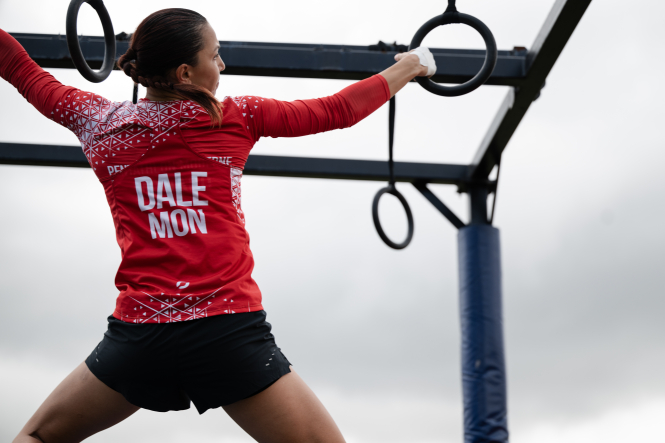
Two outstanding performances set the pace. Julia Dale of Monaco recorded the fastest women's Obstacle Racing time of 42.5sec, improving her personal best from the 2025 European Masters Championships in Madrid by 10 seconds. Jean-Christophe Perrier of France, competing in the 50+ category, produced the fastest men's time of 30sec, shaving five seconds off his previous best.
Perrier (FRA), who also collected two individual gold medals, credited his climbing background and experience coaching younger athletes. But it was his description of the Masters community that captured the spirit of the Championships.
He said: “You will see: the orange will help the yellow, and the yellow will applaud the blue ones.”
For Perrier (FRA), this spirit extends even to competitors lending equipment to their rivals. The competitive instinct is strong, but the friendships are stronger.
A first-time adventure for an Australian newcomer
Few journeys to Cape Town were more remarkable than that of Ellisa Brits (Bennett) of Australia, who had never previously competed in Pentathlon.
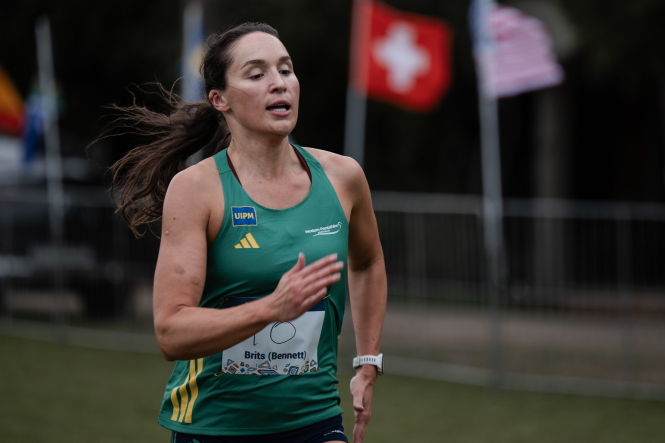
A former national volleyball player, Brits (AUS) turned towards a different sporting challenge after injury, initially looking for something relatively light. With an Olympic swimming medallist for a husband, she was no stranger to elite sport, but Pentathlon presented an entirely new adventure.
Her preparation was extraordinary. She began swimming in March 2026, added shooting in June and fencing in July, and had only taken up Obstacle Racing three weeks before the World Championships. She even travelled to Budapest (HUN) to train alongside pentathletes ahead of her international debut.
Despite her limited experience, Brits improved her personal best in Obstacle Racing and exceeded expectations in Fencing.
“It was amazing. I had a lot of fun. I'm exhausted now, but in a very good way,” she said. “The community is very friendly and welcoming. There are people from everywhere, different countries, and everyone is very friendly.”
Brits (AUS) was far from alone in discovering a new sporting passion later in life. Jenny Bobille-Vaucher of Sweden and her husband only took up Pentathlon in early 2025 after watching the Olympic Games on television. At 53, she found herself learning Fencing, laser shooting and Obstacle Racing from scratch.
Her explanation for continuing was simple: “I will continue because this is so fun.”
Olympians rediscover the joy of competing
For others, Cape Town offered an opportunity to reconnect with a sport they had known for decades.
Olympian Florence Dinichert of Switzerland, a member of the UIPM Coaches Committee, returned to competition after almost 10 years experiencing events primarily from the coaching side. Competing in the 40+ category, she won three gold medals, including a relay title alongside Katrin Niedermann (SUI).
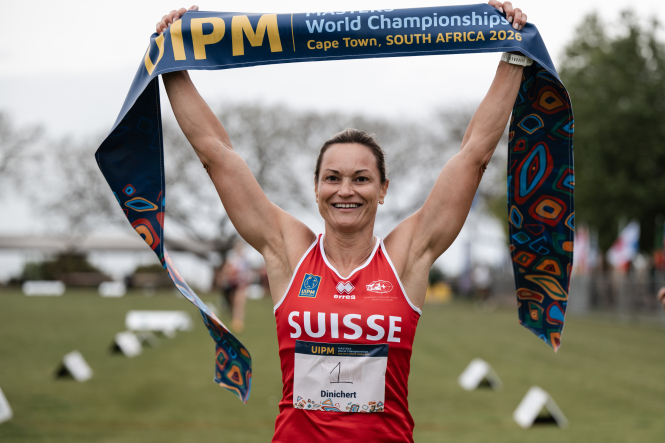
Yet the greatest reward was rediscovering the pressures, satisfaction and excitement experienced by the athletes she coaches.
Dinichert (SUI) said: “For me it's helpful to experience the feelings while competing on the field to be a better coach for the athletes.”
Meanwhile, South Africa athletes such as Tiaan Rossouw and Rupert Groenewald demonstrated another pathway into Masters Pentathlon, progressing from Biathle, Triathle and Laser Run towards Tetrathlon and Pentathlon.
UIPM Masters Committee member George Harrop-Allin (RSA), himself an Olympic fencer and competitor in Cape Town, welcomed this development.
“Being here in South Africa, it is great to see our fellow Masters who started with Biathle, Triathle and Laser Run and now practise Tetrathlon and Pentathlon,” he said. “This is the way to go – let's bring more of our friends and people who love lifelong sport activities to Pentathlon!”
Beyond the competition venues, shared experiences and friendships reinforced the feeling that Masters Pentathlon is entering an exciting period of renewal.
One phrase printed on a UIPM jacket seemed particularly appropriate throughout the Championships: “You think you can adapt? Try Pentathlon!”
For UIPM Masters Committee Chair Nathalie Denoyes (FRA), who followed the competition remotely after an ankle injury prevented her from travelling, the message from Cape Town was unmistakable.
“Maybe it has been your first competition, maybe you are a great champion. Maybe you came for a medal, maybe you came to push your limits. Just being here is already a victory,” she said.
“You show it every day: Modern Pentathlon has no age!”
As the international Masters community looks to welcome more returning athletes, newcomers and participants from other sporting backgrounds, Cape Town offered a reminder of why people fall in love with Pentathlon – and why that love can last a lifetime.
Upcoming events
